

Liquavista was a startup in the screen technology industry. It was founded in the Netherlands in 2006. The company’s primary focus was on developing electrowetting displays. This technology aimed to create e-paper screens for modern devices. These screens could function with or without a backlight.
The technology offered an alternative to E-Ink displays. Additionally, it boasted the unique ability to play video files. Most importantly, it ensured longer battery life for devices that used it.
The project started commercializing its technology in 2010, with the last step before the Samsung Electronics acquisition. In May 2013, Liquavista became part of Amazon.com Inc, and five years later, the company shut down the project.
It remains unclear whether the project has been entirely abandoned. No official announcements have been made by Amazon officials yet.
Liquavista: Overview and History
Liquavista was a startup that received funding from venture capitalists. It was founded in 2006 as a result of the corporate venturing agreement between NVP and Philips Research.
The company aimed to develop products utilizing its patented HEOS display technology. This innovative technology is based on the Electrowetting effect, developed over a decade by Philips Research Labs.
The Electrowetting effect is the basis of HEOS devices, and it has revolutionized the way high-quality displays are produced. Despite its revolutionary impact, the technology is simple to use.
Liquavista was a promising venture that aimed to bring cutting-edge display technology to the market.
Liquavista was developing the first generation of HEOS devices. They were expected to reach the market in 2007 but later delayed. The business model was based on developing relationships with supply chain partners and OEMs.
The product roadmap also included portable devices such as E-Readers, Tablet PCs, Laptops, and Smartphones. The core team in Liquavista formed the basis of that Philips effort. The intellectual property they created now belongs to Liquavista.
Philips was a passive shareholder joined by external financial investors led by New Venture Partners.
Samsung Electronics acquired Liquavista in 2010, but the deal was not disclosed. During that time, Liquavista was preparing to launch its commercial product and introduced a display platform called LiquavistaVivid. In May 2013, Amazon acquired Liquavista. However, after five years, Amazon shut down the division. It is still uncertain whether the project was closed or transferred to another part of the organization.
What is Electrowetting Display and How it Works?
Electrowetting has been a well-established scientific discipline for years and is widely used across industries. It is a versatile technology that provides benefits to many other sectors.
Electrowetting uses the natural forces of the oil and water interface. It involves manipulating these forces within hydrophobic materials.
In this process, an oil and water mixture is encapsulated by a highly hydrophobic material. It causes the water to avoid the surface by forcing the oil to act as an intermediary.
To modify the hydrophobic wetting properties, an electrical voltage is applied. As a result, the surface becomes increasingly hydrophilic.
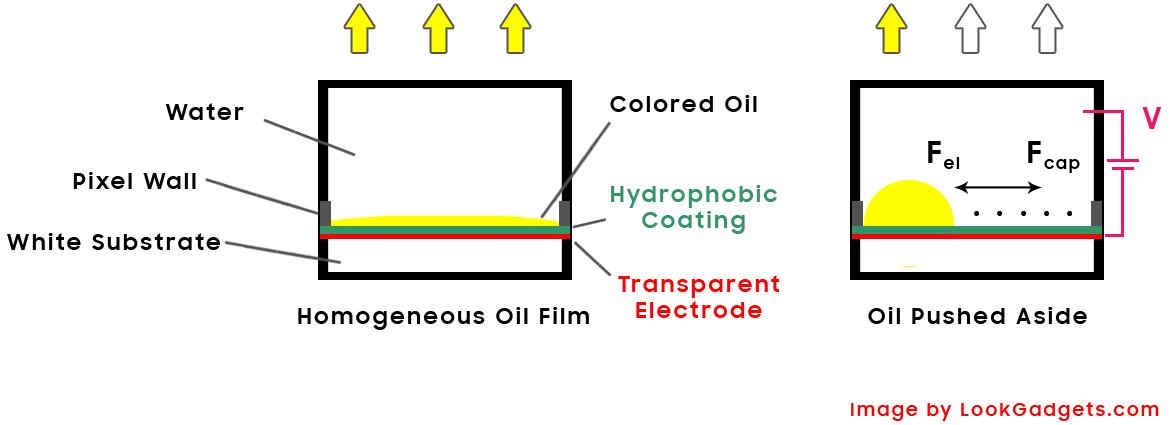
Electrowetting applications manipulate the properties of previously hydrophobic surfaces, making them increasingly attractive to water. This force causes the oil to take on an alternative form.
In display screens, Electrowetting principles are utilized to create a pixel modulator. By mixing oil with a dye, the display can develop images by allowing each pixel to be separately controlled.
Dyes can create a single color or a multi-color combination, resulting in a versatile display screen that can produce a wide range of colors and images.
Benefits of Liquavista Electrowetting Display
Display applications have been revolutionized in recent years with the availability of technologies that provide high-performance images across various applications. One example is the LCD, which has driven the availability of high-performance color displays in every application, from flat-panel televisions to smartphones. All at a cost that is increasingly within reach of the average wallet.
LCDs managed to dominate the market for a very long time. It’s mainly because of the scales of manufacturing available and their broad availability from various manufacturing sources. Moreover, their versatility in working in different environments makes them a preferred choice. However, the increasing demand for improving performance has led to the search for more efficient display technology.
The application of Liquavista’s pixel modulators is based on the principles of Electrowetting. It creates a high-speed optical shutter, which may control an unlimited number of operational greyscales. Also, the pixel modulator operates as a 2-dimensional ‘curtain’ within the pixel. None of the losses associated with viewing angle dependencies are observed with the display and interference modulators.
Indoor/Outdoor Usability
With its efficient pixel design, the Liquavista technology improves the overall performance of HEOS displays. With less than 10ms of switching between video and still images, the display delivers an exceptional experience. Whether indoors or outdoors, it offers a great viewing experience without losing image quality.
For example, LCDs lose a minimum of 50% of the light because of the polarization. Further significant light losses are incurred due to attempting to increase effective viewing angles.
Compared to the transmissive or emissive display, the HEOS displays have no limitations when placed in direct sunlight.
The Liquavista electrowetting pixel design has no limitations on viewing angles and doesn’t require any emission. As a result, the screens provide excellent performance even in the purely reflective mode. While in high ambient light environments, they perform as vividly as the high-quality color print would.
Colors
Liquavista displays are all about a revolution in color. It can achieve excellent color performance with full-color or multichromatic modes, giving us vivid color tones. Color as a display function is rendered in the most natural and obvious ways. Introducing dyes to the pixel modulator means an almost limitless variety of colors can be available.
The advantages of high-speed and efficient optical switches are used to create simple full-color displays. Compatible with conventional RGB and RGBW display modes but with significantly higher brightness and wider viewing angle. Simultaneously, combining highly efficient secondary color selections and subtractive color addressing makes the most efficient full-color electronic display technology available.
However, it is in its simplest form, perhaps, that Liquavista’s technology shows what makes it such an exciting proposition. By choosing from an almost endless range of dyes and background effects, a similarly endless array of display effects may be produced. This includes selecting specific color tones to match any product design.
Power Saving
When you see the ‘low battery’ symbol on your device, it can be stressful. Fortunately, there are different low-power display methods available, like LCDs. However, as video and animation are becoming more common in most applications, and there is a high demand for portable products, there’s a need for even better power performance.
Liquavista’s displays are not only the brightest and most vivid, but they also offer exceptional power performance. This is because the same factors that make them stand out also give them power performance.

These displays are significantly brighter than competing techniques. As a result, they require less additional illumination. In mobile handsets, for example, the backlighting system of a new screen may consume more than 20 times the power of the display itself.
Other techniques rely on bi-stability to offer low-power standby modes. However, there are some disadvantages to using this technique. For instance, generating video performance with a bistable pixel can result in high complexity and inefficiency. This causes a significant increase in power consumption.
Manufacturing
Flat panel display manufacturing has been overgrown in recent years, with significant investment in the industry. It is clear that the display industry has great importance today. When developing and promoting new technology, it is essential to consider the accessibility of large-scale manufacturing resources.
Liquavista did recognized this challenge and has designed its electrowetting display to be compatible with existing display techniques and processes.
Liquavista displays were developed to use conventional LCD substrates. In fact, more than 90% of the manufacturing cycle uses standard LCD manufacturing equipment and processes.
A proprietary low-cost, scalable fill process, performed at the biplane level and patented by Liquavista, improves the standard LCD manufacturing cycle.
Electrowetting displays use conventional modularisation, integration, and drive techniques.
Logo of Liquavista
Although the company was acquired three times since its creation, the logo of Liquavista only changed once, until now.


Why LookGadgets acquire Liquavista?
As you might already know, LookGadgets is a tech review website. We publish news, reviews, and buying guides to help you find the best products.
Since the project ended, we decided to acquire the domain (Liquavista.com) and redirect it to LookGadgets.com. Our website helps consumers to find more information and buying guides on the best monitors, home networking equipment, laptops, tablets, and gaming accessories.
As a reputable review site, we want to share content that delivers value and helps customers make the right decision.
Best Products
- Best Audiophile Headphone for FPS Gaming
- Best Surface Pro 8 Accessories
- Best Gaming Monitors under $300
- Best Wi-Fi 6 Routers in 2022
- Best Wi-Fi 6 Mesh System in 2022
- Best Game Development Laptops
- Best Surface Duo Accessories
- Best Surface Pro 7 Accessories
- Best Surface Pro X Accessories
- Best Surface Book 3 Accessories
- Best Chromebook for Students
- Best Kids Smartwatches
- Best Router for Verizon Fios
- Best Router for Spectrum Internet